
Last week we inspected attics.
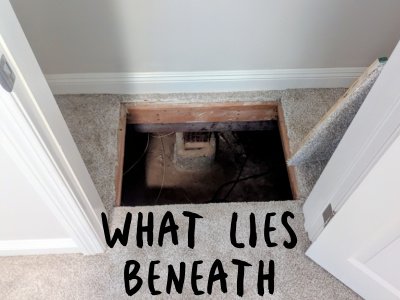 Inspecting Crawl Spaces
I can’t imagine that anyone actually enjoys inspecting—or spending time in—a crawl space. Sure, there are crawl spaces that feel more like basements, where you can stand up and walk around, but those are few and far between.
Most crawl spaces in California have an entrance that’s barely two feet high, with just enough clearance to crawl once you’re inside. There are always pipes to maneuver under or over, depending on their placement. Some homeowners use their crawl space for storage, which only adds to the difficulty. Unlike attics, there usually isn’t much wiring—just pipes, conduits, piers, and sometimes insulation.
There are also far more spider webs in crawl spaces. And then there’s the other unpleasant stuff: decomposing rodents and other animals.
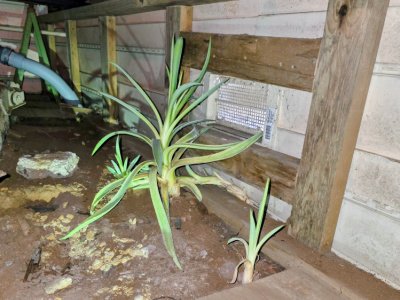 Once in a while you’ll see a plant.
Some crawl spaces are bone dry. Others are damp. The damper the crawl space, the muddier your coveralls will be by the time you’re done—and the more likely you are to find evidence of subterranean termites, drywood termites, and wood rot.
I’ve found that a strong flashlight works better than any headlamp. With a headlamp, your face has to be pointed exactly where you want the light, which means constantly craning your neck. It’s much more comfortable to aim a flashlight where you need it rather than aiming your head.
I always wear knee pads in crawl spaces, even though you’re usually crawling on dirt. Many crawl spaces are covered in gravel, and that extra cushioning is appreciated. There are times I wish I wore elbow pads too—something I still haven’t added to my gear.
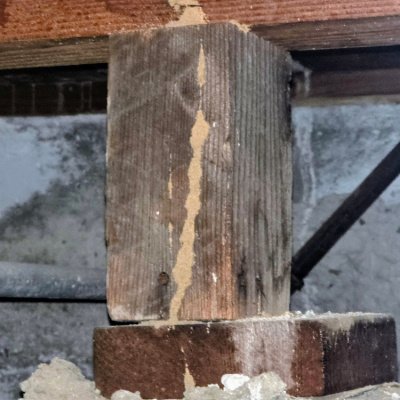 When I’m in a crawl space, I’m primarily looking for subterranean termite mud tubes and drywood termite droppings. Mud tubes often run up stem walls or piers. Drywood termite droppings are commonly found on wood framing that sits on top of the stem wall, but they can also be found on the ground below infested floor joists or wood flooring.
Beyond termites, it’s important to note anything unusual. More often than not, it’s an undetected plumbing issue that the owner is unaware of.
Like attics, crawl spaces usually have only one entrance and exit. But being at the far end of a crawl space feels very different than being at the far end of an attic. Movement is slow, obstacles are constant, and having the entire house above you can be unnerving—especially knowing there’s no quick way out. In an attic, if there were an emergency, I could break through drywall to escape. In a crawl space, I probably wouldn’t make it out in time.
I was once in a crawl space during an earthquake. I heard the emergency alert on my phone and the homeowner reacting above me—but I felt absolutely nothing. My biggest fear was happening, and I didn’t feel a thing.





1 thought on “What Lies Beneath?”
Pingback: Inspecting an Attic for Termites - California Termite and Pest Control