
I was speaking with a customer in San Marcos. She lived in a two-year-old home in a brand-new neighborhood. I’m not sure what prompted the termite inspection, but the inspector reported finding a single termite wing in her attic—and that was enough to spark a quiet panic.
Neighborhoods operate differently today. This one had a WhatsApp group where everyone stayed in close contact. That lone wing quickly turned into multiple calls to my company for inspections. Normally, I don’t spend my days inspecting nearly new homes—if I did, I’d be out of business. But the neighborhood was close, the caller was kind, and she was coordinating inspections for herself and three family members nearby.
As expected, I didn’t find any evidence of termites in any of the homes. Still, the homeowners were interested in prevention, so I ended up borating all four attics.
Later, the original homeowner—the one with the “wing”—called me. I still don’t know what triggered that first inspection. It may have been routine pest control. Many companies encourage technicians to recommend additional services, and termite inspections are often offered for free.
Here’s the part most homeowners don’t hear: termite inspectors are salespeople. They’re paid to sell, not just to inspect. Those who don’t produce often end up doing annual warranty inspections, where the pressure to sell is lower—but it’s still there.
A sales-driven inspection often starts with a quiet question: How am I going to make a sale here? In a brand-new home, that can be a challenge.
So how does someone “find” a single wing in a large attic? I’ve seen it before.
When I was new to the industry, I shadowed a more experienced inspector. We were inspecting the home of an active-duty military member who was trying to refinance a VA loan. The VA requires a termite clearance. That inspector also managed to “find” a single wing.
But let’s talk about what that actually means.
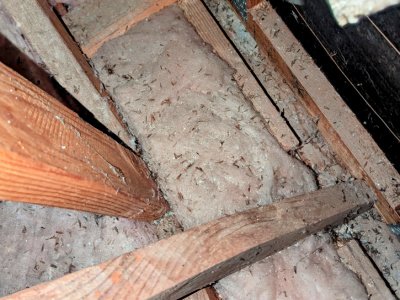 When termites swarm, they don’t show up one at a time. Swarming involves dozens—often hundreds—of termites. Each termite has four wings. A swarm of 100 termites leaves behind 400 wings. That’s what activity looks like. (This photo represents what an actual drywood termite swarm looks like.)
A single wing, by itself, proves nothing.
In fact, without magnification, you can’t even be certain it came from a termite. Ants swarm too—and they shed wings that can look very similar.
Finding one wing in an attic is like finding a drop of water in a crawl space and declaring there’s a plumbing failure. It’s not evidence—it’s speculation.
There’s a big difference between real signs of activity—like piles of droppings or visible damage—and isolated, meaningless debris. And there’s an even bigger difference between a quiet attic and a true swarm event. When termites swarm inside a home, homeowners know. It’s unmistakable. That’s when phones start ringing.
One wing is not a swarm.
One wing is not evidence.
One wing is nothing.
I still think about that military homeowner. He was trying to refinance, lower his payments, and do the right thing. Instead, he paid for a service he likely didn’t need—because someone needed to make a sale.





1 thought on “They Found a Wing”
To hear the word “termite” is like hearing “fire” to some people. I am glad you treated the mentioned situation with borate – a reasonable and effective treatment.