
Last week, we inspected the outside of the house. This week, attics.
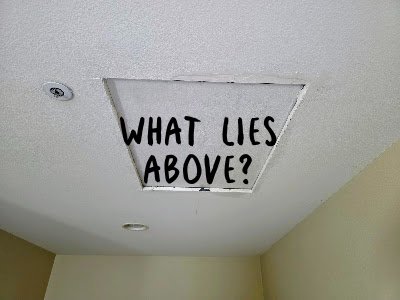 Maybe there’s something wrong with me, but I like inspecting attics. Sure, they’re dark, dirty, and full of hazards—but they’re never the same, and they’re a crucial part of a complete termite inspection.
I compare inspecting an attic to a doctor listening to a patient’s heart. If you went in for a physical and the doctor skipped that step, you’d probably find a new doctor. Same thing here. If a termite inspector skips your attic, find another termite company.
I started my career with a termite company that specialized in alternatives to fumigation, which meant I had to find every area of infestation. If I’d started with a company that leaned heavily on tenting, I probably wouldn’t be as thorough as I am today.
Some inspectors hate attics. They’ll see a difficult section and mark it “inaccessible.” Others will inspect from the ladder—basically peeking in like a gopher looking out of its hole. Inspectors like that are far more likely to recommend fumigation. They’re just not into the work.
Before entering an attic, I strap on knee pads, work gloves, and a mask. I bring a powerful flashlight, my phone for photos, and chalk to mark infested areas.
I honestly don’t know how anyone gets through an attic without knee pads. Very few attics allow you to stand and walk. Between exposed nails, truss ties, and hard framing, knee pads are the only reason I can still walk normally at this point in my career.
Sometimes, just getting into the attic is a challenge. This week I inspected a home with three separate attic access points—one above a toilet, one above a computer rack, and one above a shelf.
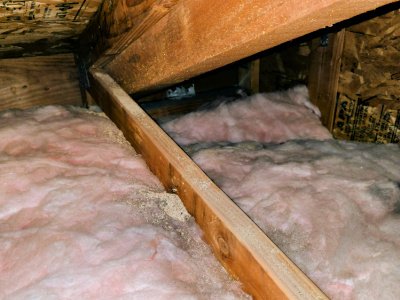 What you’re primarily looking for are termite droppings. Because attics are dry and enclosed, droppings tend to stay right where they fall. You need to know how to distinguish termite droppings from sawdust or roofing debris. Inspect an attic shortly after a new roof installation and that distinction can be tricky.
If you find droppings, the next step is figuring out where they came from. A tight, condensed pile—like sand in an hourglass—means the infested wood is close by. If the droppings are spread out, the source is higher up. If you find a crusted exit hole, called a kickout, that’s where termites are pushing material out. Damaged wood nearby is another strong indicator.
Every infestation area should be marked with chalk—a “K” (short for Kalotermitidae, which no termite inspector actually knows how to pronounce) and the year. This helps future inspections and tells the technician where to treat.
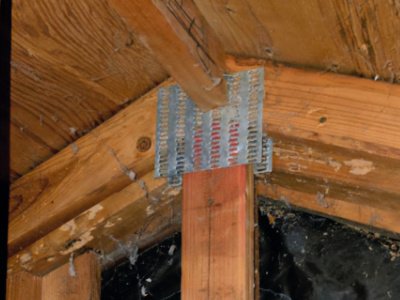 It’s also important to look for existing chalk marks. A “K 15” means the activity was noted in 2015. If the home was fumigated in 2016, that’s likely old activity. This is often where honest inspectors separate themselves from less honest ones. A dishonest inspector ignores chalk marks and fumigation tags and focuses only on the presence of droppings.
Wings are another important clue. A large concentration of wings on attic insulation means a swarm occurred in the attic—and that’s bad news. Swarms in attics often lead to new colonies because attic wood is typically unprotected, with no primer or paint to slow them down.
Borate treatments can help, but there’s no visual way to confirm whether an attic was ever borated. The only indication is a note on an inspection or treatment tag, and even then, there’s no way to know how thoroughly the application was done.
The framing around chimney flues is especially vulnerable to drywood termite infestations. Always inspect the wood surrounding chimney tubes. If droppings are present, ask whether the infested wood can even be reached for treatment. If not, fumigation may be the only option.
Darkened wood is another warning sign—it often indicates excess moisture. All termite infestations and fungal infections start with moisture. Where there’s moisture, there’s usually something bad happening.
Mud tubes mean subterranean termites. If subterranean termites have made it into the attic, there’s a serious problem.
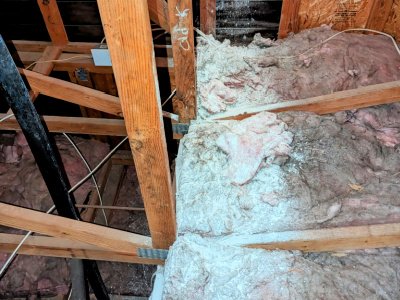 You’ll also encounter signs of past treatments: masking agents used to cover old droppings, drill holes from localized treatments, and other indicators. Droppings on top of masking agent suggest the prior treatment wasn’t effective.
As a service to your customer, you should always note rodent activity—even if your company doesn’t offer rodent services. Look for contaminated insulation, tunneling, dead rodents, and unscreened vents.
While you’re up there, watch for broken ducts, water leaks, open penetrations, and anything else that could lead to future problems. Most homeowners never enter their attics, let alone inspect them, so this information is extremely valuable.
Like I said—I like inspecting attics. When I get home after a day of inspections, I want my work clothes to be too dirty for the house. If they’re not, I probably didn’t push hard enough.



1 thought on “Inspecting an Attic for Termites”
Pingback: Inspecting a Home’s Exterior for Termites - California Termite and Pest Control