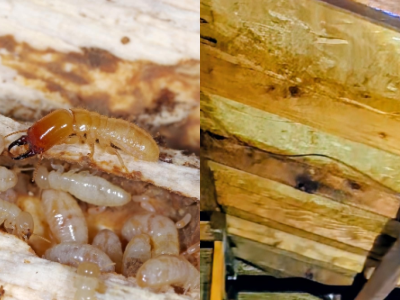
 There are different ways to poison termites.
One way is to poison the termites directly. Fumigation does this by filling the structure with gas. Homeowners attempting DIY treatments may spray visible termites with pesticide. Orange oil treatments involve drilling into termite galleries and injecting a solvent that kills on contact.
Another, often more effective, strategy is to poison their food.
When a fipronil-based product is injected into wood, it not only kills the termites present, but also penetrates the wood itself. Any termites that return to feed on that wood can be affected for years—often up to a decade.
Drywood termites live inside the wood they consume. They’re called “drywood” termites for a reason. While they don’t require much moisture, they do need some. Many areas of a home are actually too dry for a colony to thrive. But certain spots provide the conditions they need: areas near gutters, flat wood beyond the eaves where condensation forms, wood affected by roof leaks, or sections of the structure that receive little sunlight.
If these vulnerable areas are locally treated with the proper materials, they can become uninhabitable for termites.
The treatment doesn’t even have to touch the termites directly. Termites will encounter the treated wood and unknowingly spread the material throughout the colony.
Attic wood is particularly vulnerable because it is usually unfinished. Exterior paint acts as a deterrent, but attic framing typically has no protective coating. Eave wood is painted, but cracks, gaps, and exposed areas—like the tips of rafter tails—can still allow termites to enter.
Drilling and treating every board in an attic would be impractical. Fortunately, because attic wood is unfinished, it can be treated topically with borates. When applied properly, borates can protect the wood indefinitely.
Borates don’t kill termites instantly. Instead, they destroy the protozoa in the termite’s gut. These microorganisms are essential for digesting wood. Without them, termites slowly die from starvation.
So if your goal is to protect your home—and it should be—the focus should be on poisoning the termites’ food rather than just the termites themselves.
DIY sprays and orange oil treatments typically kill only on contact. Termites can detect many of these substances and will avoid them, driving the colony deeper into the structure or causing it to split into multiple colonies. I’ve seen homes where this approach made the infestation worse, not better.
Fumigation will eliminate active termites, but it provides no lasting protection. It also relies on a gas that has a significant environmental impact.
The most reliable approach is a full-structure warranty that includes annual inspections and targeted treatments when needed. This strategy helps catch problems early, reduces wood damage, and can often prevent the need for fumigation.