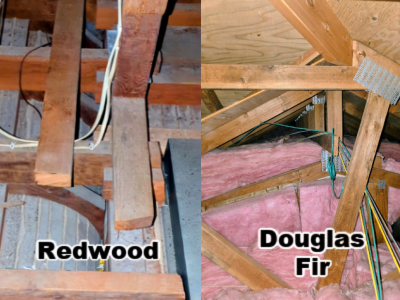
 One is like a well-done strip steak—dark, dry, and chewy. The other is a medium-rare ribeye—red, juicy, and melts in your mouth.
To drywood termites, the strip steak is redwood. The ribeye is Douglas fir.
Before the 1970s, most homes in Southern California were built with redwood. It’s a harder, drier wood, naturally resistant to termites and fungus. By the 1990s, that had largely changed—nearly all new construction was framed with Douglas fir, a softer wood with higher moisture content.
The difference shows up during inspections. When I inspect an older home framed with redwood that has a newer addition built with Douglas fir, I’m far more likely to find termite activity in the addition.
So why the shift? Why move to what seems like an inferior material?
It would be easy to blame environmentalists—and there’s some truth there. In the 1970s and ’80s, increased regulation and public pressure reduced the logging of old-growth redwood. By the 1990s, protections like the expansion of Redwood National Park and stricter forestry policies made high-quality redwood harder to obtain. As supply dropped, prices climbed.
Builders adapted. Douglas fir became the standard for framing.
And if that feels like a bad trade, spend a little time in a redwood forest. Even a short drive through leaves an impression. My daughter once camped among them and said it changed her life. Protecting those trees may be worth the trade-off—even if it means dealing with more termites.
I can’t remember the last time I inspected a newer home framed with redwood. And when I do find termite activity in an older redwood-framed home, it surprises me.
So if redwood is too rare and expensive, what can be done?
Start with borates. Treating unfinished wood with a borate solution can last the life of the structure. It makes wood resistant to fungus and essentially inedible to termites—like taking that juicy ribeye and covering it with a thick layer of salt.
Builders have options too. They can pretreat lumber with borates or bring in a termite company during the framing stage. Design choices matter as well—reducing exposed wood, especially at the eaves, can limit access. New fire regulations are already pushing construction in that direction with stucco eaves. Finer vent screens can also help keep swarming termites out of attics, garages, and crawl spaces.
Homeowners aren’t powerless either. Termite warranties with annual inspections can catch problems early. Unfinished wood in attics and other areas can be treated with borates. And if there are signs of activity, it’s best to act quickly. Early infestations can often be handled with localized treatments using a fipronil-based product—something that not only eliminates existing termites but continues protecting the wood for years.
With the cost of housing already high, builders aren’t going back to redwood. Douglas fir isn’t going anywhere.
But with the right approach, you can make it a lot less appealing—turning that juicy ribeye into something termites would rather leave alone.