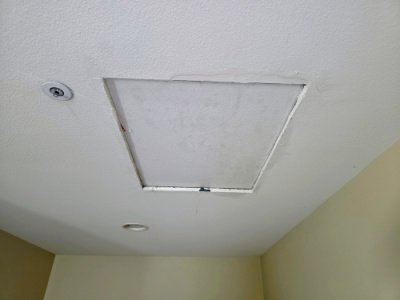
 Attic Hatches
Termite inspectors never know what they’re going to encounter when opening an attic hatch—and sometimes, just opening it is the hardest part of the inspection. Some hatches are painted shut. Others are made of wood, swollen from humidity, and require a hard shove. Some are on hinges and, if you’re not careful, will come down on your head. There may be pipes, wires, or other unseen obstacles preventing it from opening fully. And sometimes, there’s a pile of termite droppings sitting on top, just waiting to spill all over you.
Attic hatches aren’t always easy to access, either. I’ve seen them installed directly above a toilet. Some are inside narrow closets, above a shelf, forcing you to squeeze your body between the ladder and the closet wall. Others are more than twelve feet off the ground, requiring a full dip just to get your feet back onto the top rung of your ladder. Some are positioned above old-fashioned hallway lights, meaning you first have to remove a brittle plastic cover, then the hatch itself, and then reposition a light bulb pole.
Even once the hatch is open, there’s not always a clear place to set it down. You slide it one way—there’s an obstacle. You try the other direction—another obstacle. Eventually, you give up, remove it completely, and lean it carefully against your ladder.
Some attic hatches look like simple rectangles or squares but will only close properly in one specific orientation. You try it one way—it doesn’t fit. You rotate it and try again, and suddenly it seals perfectly.
And through all of this, homeowners understandably don’t want their attic hatches marked up. That’s why I keep a box of Magic Erasers on hand—just in case.
 Vents
Vents
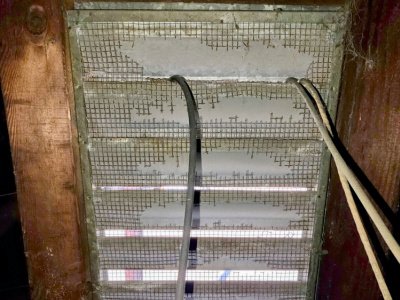
Termites spread by swarming and can gain access to attics, crawlspaces, and garages through unscreened or improperly screened vents. Because the framing in these areas is often unfinished and unpainted, termites can begin feeding almost immediately after landing.
Many older homes are equipped with vent screens made of ¼-inch mesh. In wildfire-prone areas, modern building codes often require ember-resistant vents or vent assemblies designed to reduce the likelihood of wind-driven embers entering a structure. These products frequently incorporate finer metal screening than was commonly used in older homes. While their primary purpose is fire protection, the smaller openings can also help reduce the likelihood of swarming termites entering through vents.
Damaged or missing vent screens can create more than just a termite problem. They can also provide an entry point for rodents. Attics offer rats and mice a warm, dry environment that is protected from predators. Once inside, rodents can contaminate insulation, chew electrical wiring, and leave behind droppings that may require costly cleanup and remediation.
During a termite inspection, special attention is often given to the areas surrounding attic, crawlspace, and garage vents. Vent openings are typically framed with wood, making them attractive landing spots for swarming termites. Since termites are not particularly selective about where they begin feeding, the wood framing around vents is often one of the first places inspectors look for evidence of activity.
For homeowners, keeping vent screens intact serves multiple purposes. Properly screened vents can help reduce the risk of wildfire embers entering the structure, discourage rodents and other pests from gaining access, and limit opportunities for swarming termites to establish new colonies within the home.
 Insulation
There are two main types of insulation: batt insulation and blown-in insulation.
Batt insulation comes in pre-cut sections designed to fit between rafters or wall studs. It is most commonly made of fiberglass.
Blown-in insulation is installed by using specialized equipment to distribute loose material evenly into attics, walls, or other spaces. Common types include TAP insulation and loose fill fiberglass insulation.
TAP insulation stands for Thermal, Acoustical, and Pest Control. It is made from recycled paper and treated with borate. The borate helps make the material fire-resistant and also provides pest control benefits. When insects come into contact with the insulation, the borate can dehydrate them.
Loose fill fiberglass insulation has become increasingly popular with builders, and many newer homes use this type of insulation. It is cleaner to work with than TAP insulation and is often easier to install than batt insulation.
 Duct Work
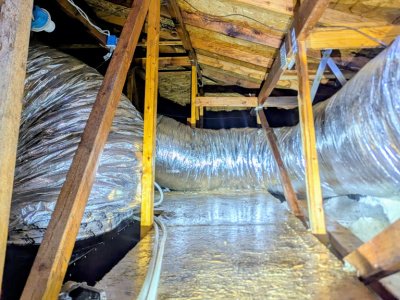
Duct work seems to be getting larger and taking up more space than ever before. Because most furnaces in California are located in the attic, this can make termite inspections more difficult. Ducting can block both the view and access to remote areas of the attic.
When new duct work is installed in an older home, installers often take the easiest path. Unfortunately, that path can make it more difficult for a termite inspector to navigate the space later on.
Inspectors must use caution when crawling through or around ducting to avoid tearing, collapsing, or disconnecting it from the furnace.
Duct work in crawl spaces can also block access to certain areas, limiting a thorough inspection.
It’s just one more obstacle termite inspectors deal with on a daily basis.
 Wiring
When you’re up in an attic or down in a crawlspace, you learn quickly that whatever path was easiest for the person who installed wiring, pipes, or anything else is the path they took. If someone needs to run a length of wire through an attic, they’re not concerned with making it tidy or inconspicuous. They’re not squeezing through the tightest sections—they’re getting the job done the simplest way possible, and they’re probably never coming back up there again.
Because of that, a termite inspector not only has to navigate an attic—which is difficult enough even without obstacles—but also work around wires, pipes, ducts, and anything else that’s been retrofitted over the years.
When inspecting an attic, it’s crucial to always keep your weight on the wood. That becomes a challenge when the area is covered in blown-in insulation or when a metal pipe spans the next rafter you need to walk or crawl on. Drop-downs are another constant test. It’s usually easy to climb up a level in an attic, but coming back down can be tricky.
Go feet first, and you risk stepping somewhere you shouldn’t—next thing you know, you’re looking down into someone’s hallway or bedroom. Go head first, and you need enough upper-body strength to lower yourself carefully. There’s nothing quite like easing yourself down, hands on a 2×4, only to realize your leg is snagged on a wire. Your instinct might be to yank it free—but doing that could mean your customer suddenly doesn’t have internet.
 Heat
Heat
It rarely gets too hot in San Diego—unless you’re in an attic.
Not all attics are scorchers, though. Some are surprisingly comfortable, especially those lined with SilverTech radiant barriers. Every now and then, you climb up expecting to get blasted with heat, only to find it cool and comfortable. That’s not always a good sign. I’ve been in attics where broken ductwork was unknowingly pumping cold air into the space—essentially air conditioning the attic without the homeowner realizing it.
Still, no matter how hot an attic gets, a termite inspector only spends a fraction of the time up there compared to a termite technician. Inspecting an attic is one thing. Treating it—say, applying borate to every rafter and joist on a 90-degree July afternoon—is a whole different experience.
Some attics are so brutally hot, you wonder how termites could possibly survive in them. But they do. Drywood termite swarmers often enter through attic vents, land on the nearest piece of wood, and settle in. Ironically, in the hottest attics, you can sometimes feel a slight breeze of cooler air coming through the vent—that’s usually where you’ll find evidence first.
Occasionally, a homeowner will say, “You can skip the attic—it’s too hot today.” But there’s too much potential activity in an attic to pass it up. Very few homeowners ever crawl their attic space, so it’s up to us to make sure nothing’s hiding up there. No matter how uncomfortable it is, it’s a critical part of a thorough inspection.
And when I’m sweating it out in an attic that feels more like a sauna, I just remind myself: At least I’m not inspecting in Phoenix.
 Rodent Traps
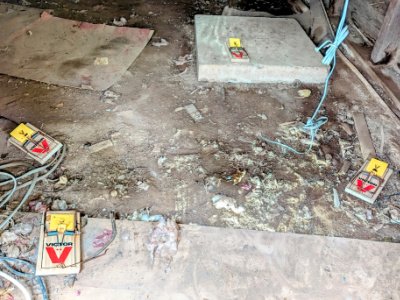
You haven’t truly inspected a home for termites until you’ve placed your hand in a rat trap or knelt on a glue board. Attic entrances are often lined with traps, and sometimes all you’re trying to do is get the lid open without injury. Crawlspaces are dark, your light isn’t always pointed where it needs to be—and traps aren’t always where you expect them. Still, I’d rather get snapped by a trap than stumble across what it was meant to catch.
Glue boards are a different kind of awful. Even without a rodent, they’re usually coated in every creepy crawler that calls the attic home.
At California Termite, we’re a high-service company. That means we often remove what others leave behind. We’re already in the attic, already dusty and dirty, and most homeowners don’t want to deal with a decomposing rodent. We don’t mind helping—but we do wonder: why isn’t the company that set the traps also checking them?
Working in attics and crawlspaces might sound rough, but I was on a cross-country flight recently, feeling bad for the crew and surprisingly grateful to be in the termite industry.
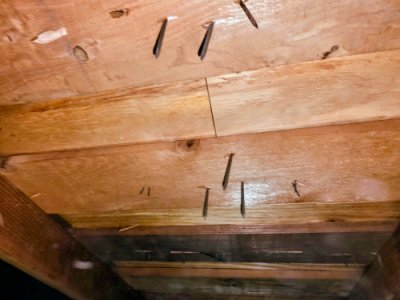 Attic Nails
I joke that I’ve hit my head on so many exposed nails that I style my hair with Neosporin. Attics are tight spaces, and it’s often difficult to crawl from one end to the other without scraping your back on the rafters and roof sheathing above. When a roofer installs a roof, the nails have to penetrate the roof sheathing. The result is a ceiling full of exposed nail tips—just one of the many hazards found in an attic.
It’s also one of the reasons so few people last in the termite business. Either they’re simply not interested in crawling through hot, dirty, cramped attics and choose another way to make a living, or they start taking shortcuts and “inspect” the attic from the access point. Skipping the attic is like a doctor refusing to listen to a patient’s heart.
Because the wood in the attic is unpainted and swarming termites can enter through multiple vents, the attic is often the epicenter of a termite infestation. Nails be damned—I’m going to continue inspecting attics as thoroughly as possible.
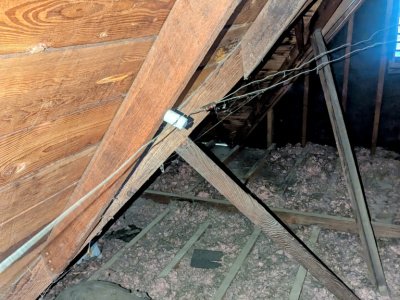 Knob-and-Tube Wiring
Knob-and-tube is an outdated wiring system that uses ceramic knobs and tubes to support and insulate electrical wiring.
In homes built before 1950, you may still see it in attics and crawlspaces. Although it’s been replaced by modern wiring, the old lines are often left in place.
Dormant or not, the wiring can look ominous. Attics are already full of hazards that termite inspectors must watch for — exposed nails, truss plates, rodent droppings… If exposed, live, electrical wiring was added to the mix, it might be enough to convince some of us to find another profession.
 Plumbing
In most cases, plumbing isn’t part of a termite inspection—unless it’s for escrow. During escrow inspections, we check under every sink for leaks and wood rot, test for loose toilets, and conduct shower stall tests.
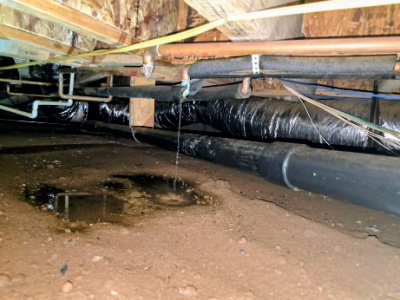
If the home has a crawlspace, it’s crucial to observe the soil conditions. If the ground is damp despite a lack of recent rain and no nearby planters, a plumbing leak is the likely culprit.
Even in a standard inspection, identifying excess moisture from plumbing issues is essential. Moisture is the driving force behind termite infestations and wood rot. Where there’s termites or fungus, there’s moisture. More often than not, tracing the problem leads back to a plumbing issue.
Left unchecked, a leak will eventually saturate the soil beneath a home, attracting subterranean termites. If framing is nearby, the added moisture can also fuel a drywood termite colony. Even the smallest leak can escalate into thousands of dollars in termite treatments and wood repairs—costs that homeowners insurance won’t cover.
 Shoe Covers
Yesterday, I inspected a home surrounded by more dirt than grass or pavement. After the recent rains, the soil was soft and muddy. The house had two crawl spaces, one of which I had to access through a hatch inside a closet. To make matters more complicated, the homeowner had a dog and wasn’t particularly vigilant about cleaning up after it.
I managed to avoid stepping in any dog droppings, but there was no avoiding the mud. Both crawl spaces were damp, and even if I had inspected the attic first—before walking outside—I still would have tracked mud back into the house when exiting the interior crawl space hatch.
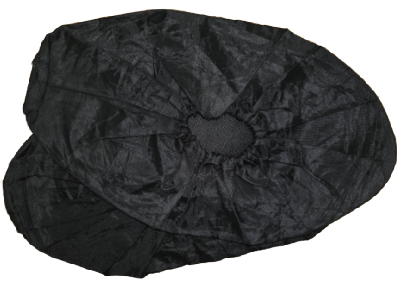
This was my first inspection of the day, which meant my boots were going to stay muddy. The only practical solution is large, waterproof shoe covers. The thin, disposable kind don’t work in situations like this—they’re usually not waterproof and tear easily. What I needed was something that would fully contain the mud so it didn’t end up on a customer’s floors.
Removing my boots isn’t an option. I can’t inspect an attic—with exposed framing, truss plates, stray nails, and uneven surfaces—in socked feet. Safety comes first.
Shoe covers can be inconvenient, especially when I’m moving in and out of the home multiple times. But there’s no way to do this job thoroughly and respectfully without them. Protecting a customer’s home is part of the termite inspection.