 I recently completed a termite inspection for an elderly woman who had discovered termite droppings beneath the sill plate along her home’s foundation. Finding droppings in that location usually means drywood termites are living inside the wall, and in most cases, fumigation is the best solution.
She told me her home had already been fumigated in 2021. Unless that fumigation had failed, five years would be unusually soon for termites to have re-established themselves inside the wall framing.
The homeowner believed she was looking at “termite eggs.” English wasn’t her first language, so I had to explain that what she was actually seeing were termite droppings. Since termites eat wood, their droppings are essentially tiny wood pellets that don’t quickly decompose. They can remain in place for years.
So how did they get there?
After showing me the droppings outside, she took me into her recently remodeled bathroom. While the wall had been open, she noticed evidence of termites in the framing. I explained that the infestation most likely existed before the 2021 fumigation and that the remodeling had probably shaken old termite droppings out of the wall, causing them to appear beneath the sill.
Over the years I’ve learned that homeowners’ memories can be unreliable. Many people aren’t sure whether their home was ever fumigated or exactly when it happened. The best evidence is a fumigation tag, usually found in the attic or garage.
I wasn’t going to rely solely on her memory—I wanted to see the tag for myself.
I entered the attic through the access opening in the garage. It was a large, single-story home, so the attic stretched across the entire footprint of the house.
Almost immediately, I noticed termite droppings everywhere.
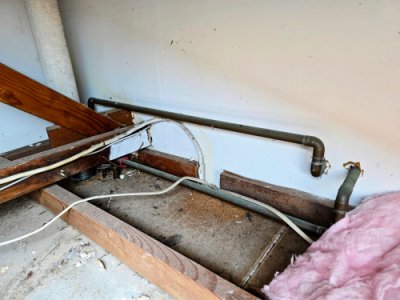 On my way to the attic access inside the home, I passed at least a dozen piles of termite pellets. There was simply too much old evidence for a home that had supposedly been fumigated only five years earlier.
Then I noticed something else.
There wasn’t a trace of masking.
When a home is fumigated, it is the termite company’s responsibility to clean up or mask existing termite evidence in accessible areas such as the attic, garage, and crawlspace. Masking—typically a white powder applied over old termite droppings—serves an important purpose. It allows future inspectors to distinguish old evidence from new activity.
If I had seen masking, I might have suspected that some of the droppings were new. But there wasn’t any.
That told me the previous company had never completed this important step.
This is exactly why masking matters.
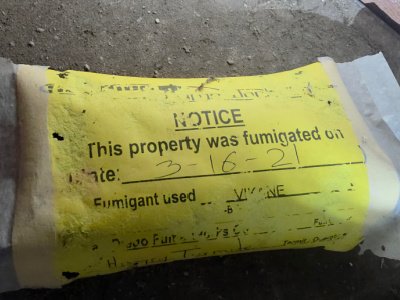
Eventually I reached the attic access inside the home and found the fumigation tag. It was dated March 16, 2021.
The homeowner wanted to fumigate again.
Before entering the attic, I had carefully probed all of the accessible exterior wood and found no evidence of an active infestation.
She didn’t need another fumigation.
She needed someone to deal with the mess the previous termite company had left behind.
Her options were to have the old termite droppings masked or to remove and replace the attic insulation altogether. Considering the insulation was old and inadequate anyway, replacing it wasn’t a bad option.
Ironically, one reason to fumigate again would be that a more conscientious termite company would finally clean up or mask the old evidence as part of the process. But that would cost far more than simply addressing the existing droppings, while also requiring her to move out temporarily and go through all the inconvenience that comes with tenting a home.
I considered suggesting that she contact the company that performed the original fumigation. After looking them up online, I discovered they were no longer in business.
I wasn’t surprised.
Many homeowners get multiple estimates before deciding to fumigate. Since the fumigation itself is often subcontracted, they assume every company is essentially selling the same service, so the lowest price wins.
But not all fumigations are created equal.
A quality fumigation begins with a thorough inspection. Every area of infestation should be identified and documented so old termite evidence isn’t mistaken for new activity years later. The warranty should be meaningful, with follow-up inspections rather than relying solely on the homeowner to report problems. If a fumigation fails, regular inspections increase the likelihood that it will be discovered early.
And just as importantly, old termite evidence should be cleaned up or properly masked.
If it isn’t, you could find yourself in the same situation as this homeowner—thinking you need another fumigation when, in reality, you’re simply looking at evidence that should have been addressed years ago.