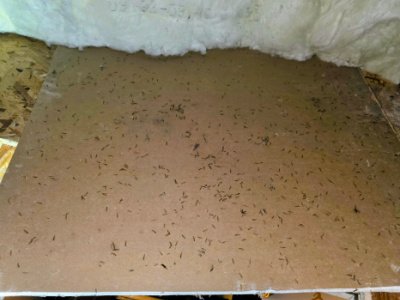
 Nothing puts termite control at the top of a homeowner’s mind quite like a swarm of termites.
I’ve inspected homes where termite-damaged eaves had been ignored for years. I’ve met homeowners who admitted they’d been sweeping up termite droppings for months—sometimes even years—without doing anything about it.
But a cloud of flying termites changes everything.
Interestingly, I’ve never personally witnessed a drywood termite swarm inside a home. However, I’ve heard dozens of firsthand accounts from homeowners.
Here’s what I’ve learned:
- It’s jarring. Hundreds of flying termites suddenly appear, seemingly out of nowhere, like water bursting from a broken pipe.
- It’s sudden. One moment you’re deciding what to make for dinner. The next you’re in the middle of a termite explosion.
- It turns people into killers. If there’s a can of Raid nearby, people grab it and start spraying. “Kill them!” If there isn’t, they’ll use whatever they have. Windex, apparently, is a surprisingly popular substitute.
- It motivates action. Homeowners who were undecided about treatment suddenly call me as though I’m 911 for termites.
Termite swarmers leave a mature colony with one objective: start a new one.
Along the North County coast of San Diego—Carlsbad, Encinitas, Oceanside, and surrounding communities—drywood termites are the species we deal with most often.
Drywood termites typically swarm in late summer and fall on warm, humid days. Subterranean termites usually swarm in the spring. While subterranean swarms can certainly be alarming, they’re generally looking for moist soil rather than the wood inside your home.
 Drywood termite swarmers instinctively fly toward the brightest light source, which is why they’re often found around windows, sliding glass doors, and skylights.
After landing, they shed their wings, pair up with a mate, and, if they’re fortunate, find a small crack or crevice in wood where they can start a new colony.
Finding a pile of discarded termite wings is a little like finding a pile of honeymoon-suite undergarments. You know exactly what just happened.
The overwhelming majority of swarmers never survive long enough to establish a colony. Nature is stacked against them. But the small percentage that do are enough to support a multi-billion-dollar termite control industry.
When homeowners experience a swarm, they naturally focus on where the termites landed.
From a treatment standpoint, however, where they came from is much more important.
Drywood termites can emerge through a hole no larger than the tip of a pencil. While everyone is watching the swarm, the final termite exits, leaving behind a tiny opening that’s nearly impossible to find afterward.
If that exit hole can be located, it often points directly to the colony, allowing a termite company to perform a targeted local treatment rather than treating blindly.
When homeowners show me where the termites landed, I’m usually looking overhead for where they may have originated.
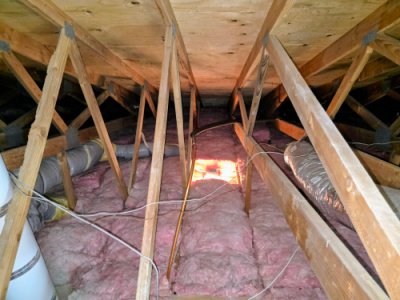
One common clue is recessed lighting. Above the fixture may be an attic or an enclosed framing cavity separated from the room by drywall. If the termites are coming from the attic, a local treatment may be possible. If they’re emerging from inaccessible framing inside a wall or ceiling, fumigation may be the only option.
August marks the beginning of drywood termite swarming season. If it happens to you:
- Try to identify where the termites are emerging—not just where they’re landing.
- Capture a few specimens for identification.
- Take photos and videos before cleaning anything up.
- Call a reputable termite company as soon as possible.
Doing those four things may provide enough information to make a targeted local treatment possible—and potentially save you the expense and inconvenience of tenting your home.