
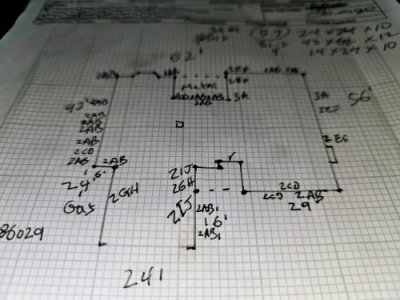
 My last post discussed the Field Worksheet. That’s what a termite inspector creates during a termite inspection. It is often a crude diagram filled with codes and markings that would make little to zero sense to a homeowner.
The California Structural Pest Control Board, the governing body of the pest control industry, requires that a homeowner be provided with a formal termite report within ten business days of the initial termite inspection. So how does the inspector’s field worksheet—think caterpillar—become the final, official-looking termite report—think butterfly?
This is accomplished in a number of different ways. I’ve worked for several different companies, and they all did it differently.
At the first company I worked for, the process was so cumbersome it almost ended my career in termite control. I had to complete both a graph of the property and a field worksheet. I would then scan and email them to someone at the company headquarters. That person would create an electronic version of the report, but without a diagram of the house that had been inspected. I would then have to print that report, take the diagram I had created, shrink it on a copy machine, and tape it to the report. Then I’d rescan the whole thing and our office manager would email it to the customer.
Most of the companies I worked for had administrators enter the information from my field worksheet, including the diagram, into software that would generate a formal termite report. As long as my worksheet was clear, all I had to do was hand off my paperwork and let the administrators take it from there.
The last company I worked for had the inspectors create their own reports. That experience prepared me for doing the same thing when I started my own company. Unfortunately, the software they used wasn’t very good. It was almost impossible to create diagrams of homes with straight lines. Many of my diagrams looked like I had tried drawing them while riding on a merry-go-round.
The system I use now is pretty simple. It creates detailed, easy-to-read reports with diagrams that actually have straight lines. I can type a report in about twenty minutes, download it, and attach it to an email. If I’m re-inspecting a home, I can work from the report I created the previous year, cutting the time needed to create the report roughly in half.
One of the best things I did when starting my company was become proficient in all of the tasks involved in the termite industry. The people running the pest control company where I got started must not have done the same thing, because there’s no way they would have expected their employees to do what they had to do just to produce a termite report. Maybe they do things differently now, but the amount of time being wasted across such a large organization must have been substantial.
There’s one last step in the process of creating and delivering a termite report to a customer: registering the inspection with the California Structural Pest Control Board.
Before I started my company, I assumed an actual copy of the report was sent to the Board and made available to the homeowner or any future owners of the property. That’s not the case. The Board requires the pest control company to register the inspection and pay a fee. The report itself stays with the pest control company.
It’s something to keep in mind when you hear that most termite companies offer free inspections. They’re free to the customer, but they’re not free to us.



1 thought on “Creating Termite Reports”
Pingback: The Field Worksheet - California Termite and Pest Control